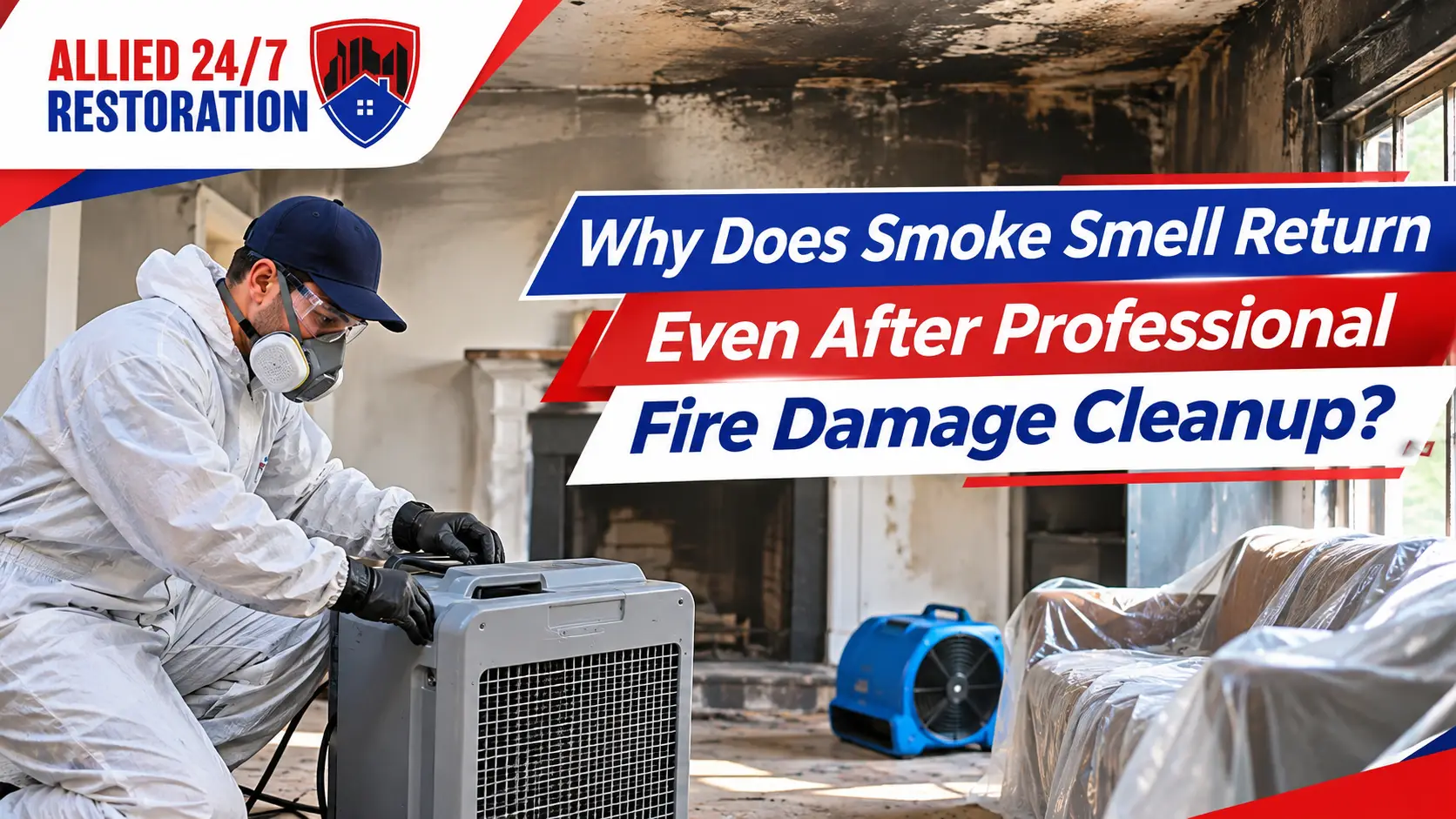

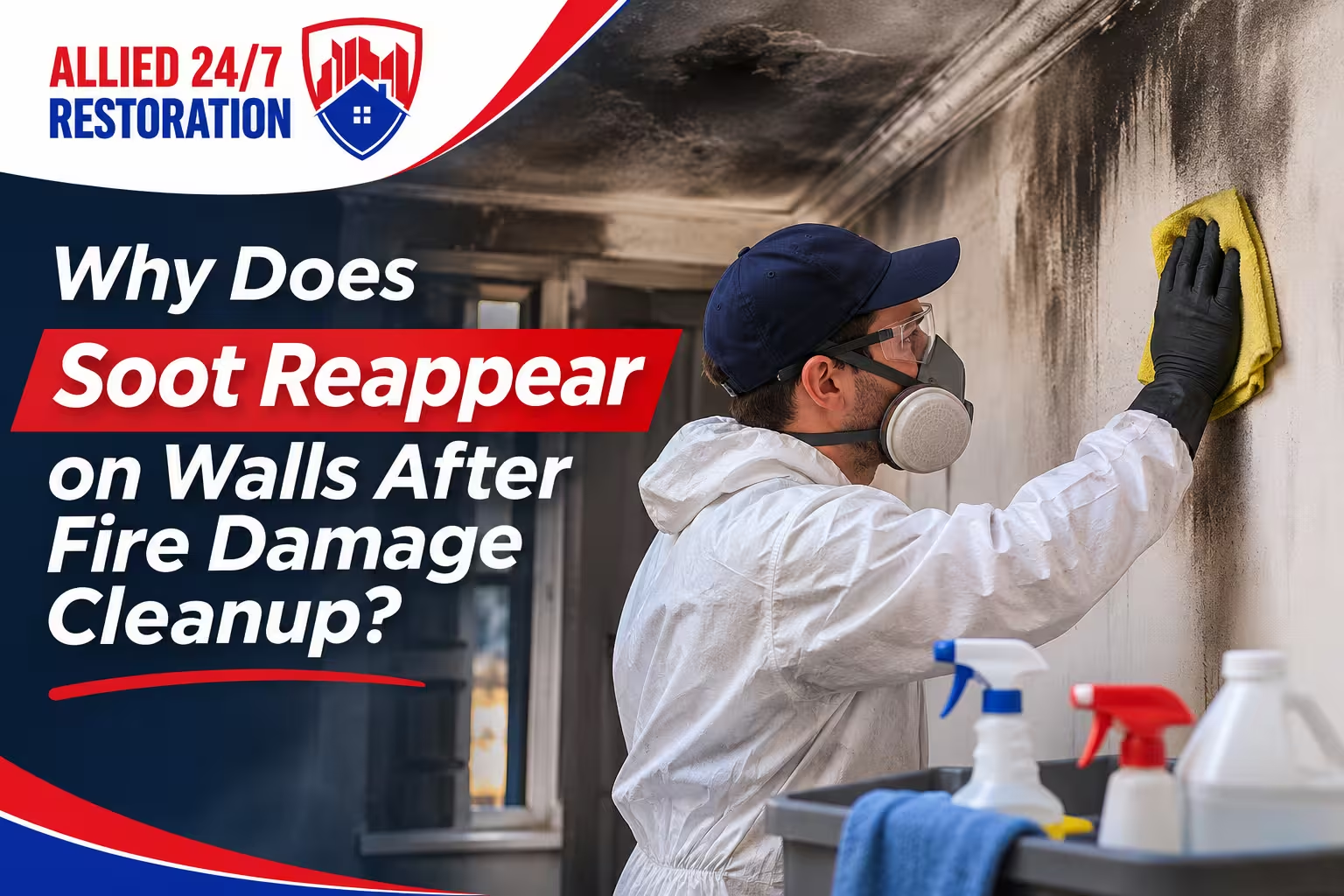
The cleanup crew packed up, and your walls finally looked normal. Then a week or two later, gray shadows crept back near the ceiling line. That’s maddening after you already paid for cleaning. Soot on walls after fire cleanup usually returns for one of a few reasons. Some residue never got fully removed. Loose particles are still drifting around and landing again. Or porous materials held onto contamination that’s now bleeding through paint. None of this means there was another fire. Soot doesn’t grow back on its own. Something is feeding it, and the fix depends on finding out what.
Why Does Soot Reappear on Walls After Fire Cleanup?
A wall can look clean and still hold fire residue. Soot is fine enough to hide in texture and on trim.
Some Soot Residue Was Never Fully Removed
Most cleaning knocks off the heavy black film you can see. Fine particles often stay behind in textured drywall, inside corners, and on top of door casings. Foot traffic and furnace airflow can lift that residue and spread it. Within weeks, it shows up as a gray haze where the fire hit hardest. A clean-looking wall only means the visible layer is gone.
New Particles May Be Settling on Cleaned Walls
Here the wall really was clean, and fresh soot was landing on it. Smoke pushes fine particles into carpets, closets, and fixtures. Disturb them and they go airborne again, which pros call particulate resuspension. Airborne particle circulation carries them until soot particle deposition happens on a wall or ceiling. Unlike leftover residue, new deposits point to an active source somewhere else. Wiping the wall again won’t touch it.
The Marks May Be Stains Rather Than Fresh Soot
Sometimes the loose soot is gone, and the discoloration is soaked into paint or drywall paper. Smoke stains aftera fire bleed through new paint when walls weren’t cleaned and sealed first. The result is persistent soot stains on a fresh coat. Touch the mark lightly with a clean white cloth. Black transfer means something is sitting on the surface. No transfer usually means smoke staining inside the finish.
What Causes Soot Residue to Remain After Cleaning?
Three things decide how much residue survives a cleanup. What burned? What the soot landed on. How someone tried to clean it.
Different Fires Leave Different Types of Soot
Soot is combustion residue, and its makeup depends on what burned and how hot the fire ran. Hot, fast fires in wood or paper tend to leave dry soot residue that’s powdery. Slow, smoldering fires involving plastics usually leave oily soot deposits that smear and cling.
Most house fires leave some of both. Each type carries fine particulate matter and other combustion byproducts. A method that lifts dry soot can just push oily soot around.
Porous Surfaces Can Hold Smoke Contamination
Drywall, unfinished wood, and popcorn ceilings have tiny openings that smoke works into. Porous surface absorption puts residue below the surface where a rag can’t reach.
Not every porous surface is ruined. Lightly affected drywall often cleans up and seals fine. Heavier contamination may need specialized treatment. Charred or saturated fire-damaged building materials usually need replacing.
Incorrect Cleaning Methods Can Spread Residue
Soapy water is often the wrong first move. Water and household cleaners can turn some soot into a smear that sinks into flat paint. Hard scrubbing spreads residue and can polish paint so the mark looks worse.
Those are classic fire soot cleaning problems. Pros often start with dry removal on suitable residue. Structural surface cleaning only works when the method fits the soot and the material. Otherwise, surface contamination just moves around.
Can an HVAC System Cause Soot to Appear on Walls Again?
Smoke doesn’t stay in the room where the fire started. A running heat or AC system can pull it straight into the ductwork.
Smoke Particles Can Remain in HVAC Components
Return vents draw smoky air toward the furnace during a fire. Residue can build up on the filter, inside return ducts, and on parts like the blower. If smoke may have reached the system, get it assessed. A filter that sat through a fire usually needs replacing.
Air Circulation Can Redistribute Remaining Particles
When the system restarts, HVAC filter contamination and loose duct debris can feed smoke residue migration. Particles drift out of supply registers and settle nearby. Gray fan shapes around a register deserve a look. So does soot in a bedroom the fire never touched.
How to Recognize Possible HVAC-Related Soot Deposits
Black marks near air vents that keep coming back are one clue. Smoke odor when the heat kicks on is another. Neither proves the system is guilty, since dust can leave similar marks. An inspection should confirm contamination before anyone recommends duct cleaning or new parts.
How Can You Tell Why Black Marks Are Returning on Your Walls?
The location, look, and timing of wall discoloration after a fire can hint at a cause. Looking alone can’t confirm the source.
| What You Notice | Possible Explanation | What Needs to Be Checked |
| Dark marks return in the same locations. | Residual soot or incomplete surface cleaning | Original affected surfaces and cleaning results |
| Discoloration appears through fresh paint. | Stain bleed-through or incomplete preparation | Surface condition, cleaning, and sealing |
| Dark deposits appear near air vents. | Possible HVAC-related particle redistribution | Filters, registers, and relevant HVAC components |
| Several rooms develop new dark deposits. | Broader smoke contamination or airborne particles | Other affected surfaces and air pathways |
| Staining appears on textured or porous walls. | Residue retained within the material | Material condition and cleaning suitability |
These are clues, not diagnoses. Black soot on walls can come from old residue and smoke particles in house air at once. Staining and leftover soot can also overlap on the same patch. When soot keeps coming back on walls, an assessment sorts out what’s really going on.
How Do Professionals Prevent Soot From Returning After Cleanup?
Stopping recurring soot takes two things. Find where the contamination went. Then treat each material correctly.
Identify the Full Extent of Smoke and Soot Contamination
A good post-fire cleaning assessment goes past the obviously stained walls. Ceilings take a heavy hit because smoke rises. Trim and closet interiors can hold residue too. The fire damage assessment should also trace the smoke’s path to find hidden residue.
Remove Residue Using Appropriate Cleaning Methods
A HEPA vacuum is often the first tool on loose, dry particulates because it traps fine particles. It won’t remove oily residue or set-in stains, which need methods matched to the surface. Air filtration usually runs during the work to catch stirred-up particles.
Address Contaminated Materials and Hidden Sources
Some porous materials won’t come clean and may need sealing or replacement as part of smoke damage restoration. The HVAC system belongs on the list when smoke exposure is suspected. If soot is coming from a hidden source, scrubbing the same wall forever won’t fix it.
Prepare Walls Properly Before Repainting
Paint is a finishing step, not a cure. Painting over soot or smoke staining usually means the discoloration comes back. Clean, dry, and recheck the wall first. A stain-blocking sealer goes on when staining remains. Some walls need drywall repair or replacement instead.
IICRC S700 is the industry’s standard for professional fire and smoke damage restoration. Still, no single step guarantees soot never returns.
When Should You Get Another Fire Damage Assessment?
Repeated soot usually means a source nobody found or restoration that wasn’t finished. Watch for these signs:
- Residue returns after more than one cleaning.
- Staining spreads to walls or ceilings that looked fine.
- Discoloration shows through fresh paint.
- Deposits appear near vents or in several rooms.
- Smoke odor lingers with visible marks.
- You can’t tell whether drywall can be cleaned or needs replacing.
Stop scrubbing. Each round spreads residue and kicks particles back into the air, and you don’t know what that residue contains. Get a professional fire and smoke damage assessment when the cause isn’t clear. Fix the source, not just the look of the wall.
Frequently Asked Questions
Why does soot come back after walls have been painted?
Paint covers discoloration but doesn’t remove it. Leftover soot or smoke staining can bleed through if the wall wasn’t cleaned and prepared first. A suitable stain-blocking sealer helps when staining remains.
Can an HVAC system spread soot to clean rooms after a fire?
It can. Residue in filters or ducts may get carried into rooms the fire never reached. Only an inspection can confirm whether the system is actually the cause.
Should you keep cleaning walls if black soot stains return?
No. Repeated wiping can spread residue and wear down paint without fixing the cause. First figure out whether it’s leftover soot, new deposits, or stain bleed-through.
Final Thoughts
Soot that returns after cleanup almost always has a reason. Usually it’s leftover residue, particles still moving through the house or stains that got painted over instead of treated. Finding the source matters more than extra wiping or another coat of paint.
Allied 24/7 Restoration brings more than 31 years of local experience to fire damage restoration. The team answers emergency calls 24/7 and works with homeowners and businesses across Kalispell and the Flathead Valley. If soot or smoke stains keep showing up on your walls, call Allied 24/7 Restoration at (406) 756-4357 to get the damage properly assessed.