
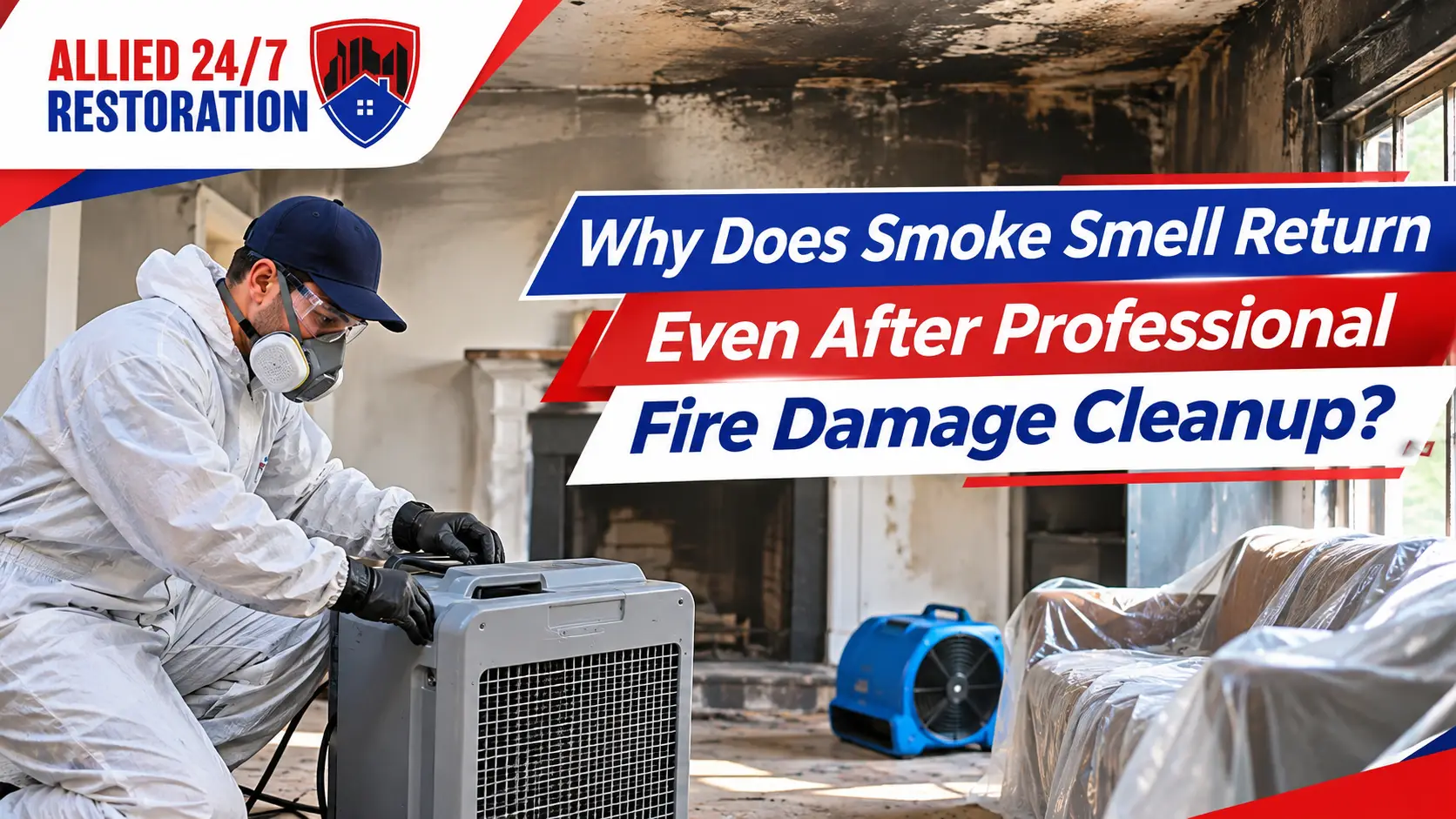
The crew packs up after fire damage cleanup, the walls look clean, and the house finally smells normal. Then a week or two later, you walk in the door, and that stale, burnt odor is back. A smoke smell after fire cleanup is frustrating, and it happens more often than most homeowners expect. It doesn’t mean you imagined the fresh air. In most cases, it means the source of the odor was not fully removed. Removing the soot you can see is one job. Removing the odor is a different one. Below are the hidden residue and porous materials, then furniture and HVAC systems, plus what you can do about each.
Why Does Smoke Smell Return After Fire Damage Cleanup?
The smoke smell comes back because something in the house is still holding it. Cleaning walls only proves the surface got wiped. They say nothing about what sits behind the paint. Two things usually drive the problem. Residue hides where cleaning never reached. Then trapped compounds slowly leak back into the air.
Smoke Residue Can Remain After Surface Cleaning
Soot is just the part of smoke you can see. A fire also leaves oily films and particles far smaller than a speck of dust. Some of it works into cracks and outlet boxes, or into the pores of bare wood and drywall. How deep it goes depends on the material and what burned. A kitchen fire can leave a nearly invisible protein film. It smells far worse than it looks.
Odor-Causing Compounds Can Be Released Over Time
Smoke carries odor-causing compounds that act like gases. Many are volatile organic compounds, or VOCs. Some soak into materials. That is absorption. Others cling to fibers and tiny pores. That is adsorption. Later, the material lets them go through desorption. Heat speeds it up, and that heat-driven release is called thermal desorption.
What Hidden Sources Can Cause a Lingering Smoke Odor in a House?
Persistent smoke damage odor almost always has a physical source. Usually it sits somewhere nobody cleaned. It might be inside a wall or deep in a duct. The good news is that a source can be found. Once you know where the smell lives, the fix gets much clearer.
Smoke Trapped in Drywall, Insulation, and Wall Cavities
Drywall is gypsum wrapped in paper, and both soak up smoke. Insulation is full of air pockets. Smoke slips into wall cavities through outlets and baseboard gaps, reaching the wood framing. A wall can look spotless while the space behind it smells like a campfire. Lightly affected drywall can be cleaned and sealed with an odor-blocking primer. That only works when residue is minor. Heavy damage usually means replacement.
Smoke Odor in Furniture, Carpets, and Personal Belongings
Cushions and mattresses have thick foam that holds smoke deep inside. Curtains and carpet padding trap residue too. Often the house gets treated while belongings sit in storage. Then everything comes home untreated, and the smell rides along. Some items clean up well. Others cost more to restore than replace.
HVAC Systems Can Redistribute Smoke Contamination
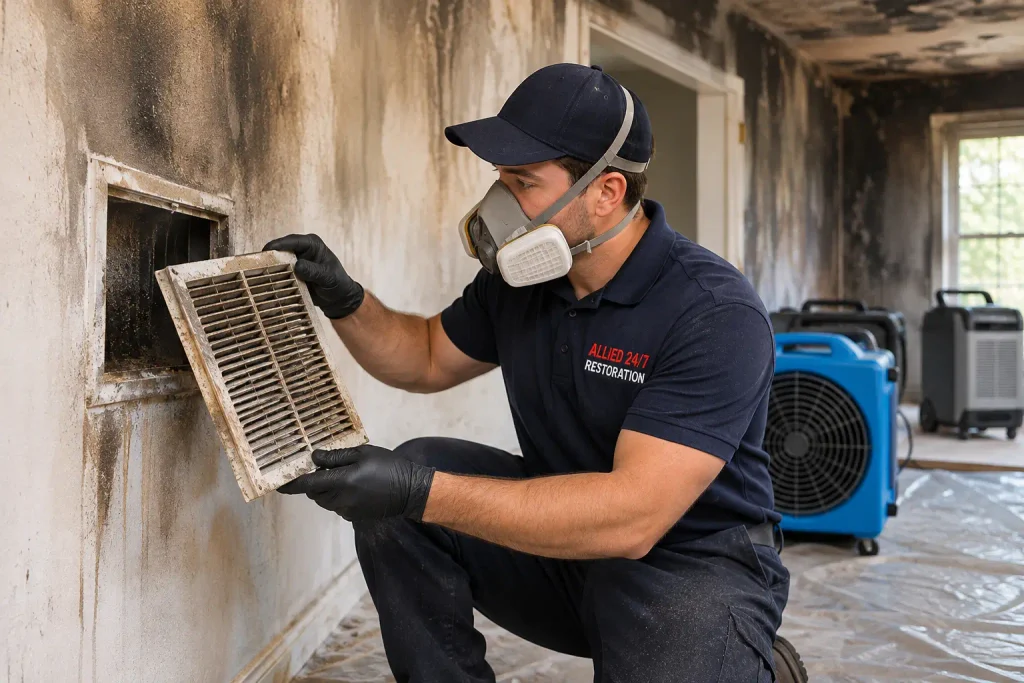
If a forced-air system ran during the fire, the return vents may have pulled smoke into the ductwork. That can coat the filter and the blower. Turn the system on later, and it pushes residue into rooms you already cleaned. Not every system gets contaminated. Still, get it inspected before normal use. A new filter alone usually isn’t enough.
What Makes Smoke Odor Become Noticeable Again?
These conditions don’t create new smoke damage. They wake up contamination that’s already there. That is why a house that smelled clean on Monday can smell burnt by Friday. The table below shows the most common triggers. Each one hints at where the hidden source might be.
| Condition | How it can affect smoke odor |
| Higher humidity | Damp air can change how odor compounds release. |
| Warmer temperatures | Heat speeds up their release. |
| Running the HVAC system | Moving air spreads duct residue between rooms. |
| Disturbing affected materials | Drilling or remodeling can expose hidden residue. |
| Bringing belongings back | Untreated furniture can carry odor into clean rooms. |
A sudden spike tells you where to look. In regions with cold climates—such as homes throughout Montana’s Flathead Valley, from Whitefish to Bigfork—that moment often arrives on the first cold night of fall when the furnace kicks on for the season. Warm air rushes through the ducts. Soon the whole house smells like an old campfire again.
Why Doesn’t Professional Smoke Odor Removal Always Work the First Time?
Deodorizing is one tool, not the whole job. When it falls short, the treatment usually missed the contamination. Or it did not fit the material. That isn’t always anyone’s fault. Smoke travels in ways that are hard to predict. Three gaps come up again and again.
Treating the Smell Instead of Removing Its Source
Fragrances cover odor. Counteractants can pair with some odor molecules and reduce the smell. Neither one pulls soot out of a wall cavity. Neither one draws smoke out of a mattress. Odor neutralization works best after the source has been cleaned out or torn out.
Using the Same Treatment for Every Surface
A sealed hardwood floor holds smoke differently than a wool rug or bare drywall. Thermal fogging heats a deodorizer into a fine fog that follows the paths hot smoke took. But the home must be empty during treatment, and fogging does not replace cleaning. Don’t confuse it with thermal desorption, the natural release of trapped compounds.
Air treatment technologies must also match the job. Hydroxyl generators use UV light and ambient humidity to break down airborne odor compounds. For physical filtration, HEPA air scrubbers pull fine soot particles out of the air but cannot capture gases, while activated carbon filters adsorb VOCs and odor-causing gases until saturated. These are air-deodorizing tools, not substitutes for cleaning physical surfaces
Missing the Need for a More Thorough Odor Assessment
A walkthrough only shows what is visible. Smoke drifts into attics and crawlspaces where nobody looks. If the assessment missed those spots, the treatment plan did too. Odor source identification means pinning down the exact room and material. That detail decides the fix. Some materials get cleaned or sealed. Others have to go.
How Can Restoration Professionals Find and Remove the Source of Returning Smoke Odor?
The approach depends on fire severity and the materials involved. How far the smoke spread matters too. One industry reference is the ANSI/IICRC S700 Standard for Professional Fire and Smoke Damage Restoration. It was first published in 2025. It covers assessment and odor management. It also covers checking results after the work.
- Reassess the affected property. Note where and when the smell shows up.
- Identify hidden contamination. Check porous materials, attics, and contents.
- Evaluate the HVAC system. Inspect filters, ductwork, and returns for residue.
- Remove or clean affected materials. Match the method to each material’s condition.
- Apply targeted odor treatment. Pick a method that fits the space.
- Verify the results. Recheck treated areas for odor.
What Should You Do If Your House Still Smells Like Smoke After Cleaning?
Don’t hide the smell. Right now it is your best clue. Covering it up only makes the source harder to track down. A few simple notes can save a restoration crew a lot of guesswork. They also help you explain the problem clearly on the phone.
- Track when the smell shows up, like after the furnace runs.
- Note which rooms or belongings smell the strongest.
- Ask if your furniture was treated.
- Skip air fresheners. They mask the odor and hide the source.
- Keep a smoky HVAC system off until it’s checked.
- Call a qualified restoration pro for a follow-up inspection.
Frequently Asked Questions
How Long Can Smoke Smell Last After Professional Fire Cleanup?
It can last until the source is dealt with. There is no set number of days or weeks. A light surface problem may fade quickly once cleaned. Smoke soaked deep into porous materials can keep releasing odor for a long time. Severity matters most, along with whether every source was found.
Can Smoke Smell Come Back From Inside Walls After Cleaning?
Yes. Residue inside drywall and insulation can keep releasing odor after the wall surface looks clean. Framing can hold it too. The fix depends on the material’s condition. Lightly affected walls may be cleaned and sealed. Heavily affected ones usually need to come out. A careful inspection shows which case you have.
Does HVAC Cleaning Help Remove Smoke Smell From a House?
It can, when the system is part of the problem. Cleaning contaminated ducts and parts stops the system from spreading odor through the house. It won’t fix smoke trapped in walls or furniture, though. Those other sources still need their own attention, so treat duct cleaning as one piece of the job.
Final Thoughts
Smoke odor comes back when something is still holding it. Lasting results come from finding and removing that source. Allied 24/7 Restoration provides fire damage restoration in Kalispell and across Montana’s Flathead Valley, including Columbia Falls. Led by owner Tim [Insert Last Name], the team brings more than 31 years of local experience and over 1,500 successful jobs to every restoration project.
The team is available 24/7 for emergencies. If the smoke smell has returned in your home, call Allied 24/7 Restoration at (406) 756-4357. You can talk through what you’re noticing or set up an assessment.