
A musty smell in the basement, water staining around a window, or a patch of suspicious growth can make any homeowner wonder what to do next. Should you schedule a mold inspection or pay for mold testing?
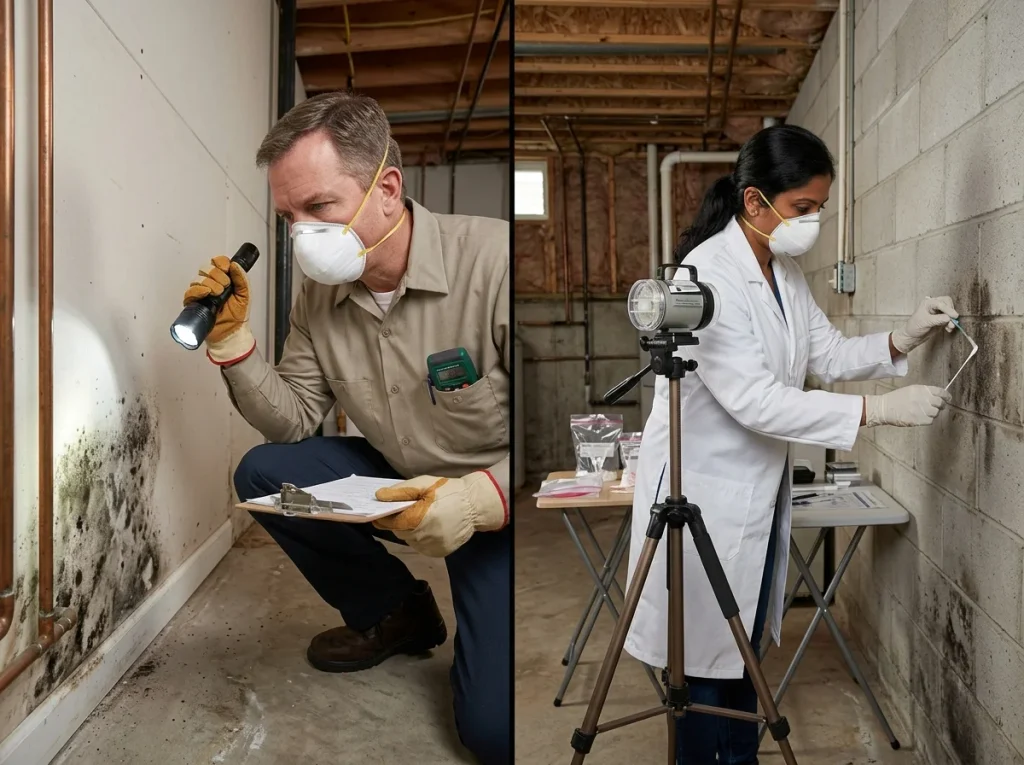
Although the terms are often used together, they are not the same service. A mold inspection looks at the property itself. It focuses on visible growth, moisture, water damage, humidity, and areas where mold may be hiding. Mold testing involves collecting samples from the air, a surface, or a building material and sending them for analysis.
For many Kalispell homes, an inspection is the better starting point. When mold is already visible, the bigger questions are usually where the moisture came from, how far the problem extends, and what needs to be fixed. Testing can be useful when a specific question remains unanswered.
Mold Inspection vs. Mold Testing: The Main Difference
Think of a mold inspection as an investigation of the home and testing as an investigation of a sample.
During an inspection, the professional checks areas that may have moisture or mold concerns. This can include basements, crawl spaces, attics, bathrooms, kitchens, windows, and spaces around plumbing or HVAC equipment. The goal is to connect signs of mold with the conditions that allowed it to grow.
Testing involves collecting air, surface, or bulk samples for analysis. The results may provide information about the material or airborne particles present when the sample was taken.
Testing does not replace an inspection. A laboratory report cannot show where water is entering the building or whether an ongoing moisture problem remains.
What Happens During a Mold Inspection?
A thorough inspection starts with a visual assessment. The inspector looks for mold growth, staining, damaged materials, musty odors, condensation, plumbing leaks, and evidence of previous water damage.
Moisture is a major part of the investigation because mold needs moisture to grow. Depending on the property, an inspector may use moisture meters to identify damp materials or humidity meters to check indoor conditions.
Thermal imaging may also be used to spot temperature differences that deserve a closer look. It does not prove mold is present. Instead, it can help identify areas that may need further investigation.
If hidden growth is suspected, a borescope or another minimally invasive method may help examine a concealed space. Any investigation of hidden mold should be handled carefully because disturbing affected materials can release particles into the air.
Cleaning growth without dealing with an active leak, seepage, condensation, or other moisture source can allow the problem to return.
What Is Mold Testing?
Mold testing means collecting a sample and having it analyzed. The right sample depends on what you are trying to find out.
Air Sampling
Air sampling measures airborne particles during a specific period. Indoor results may sometimes be compared with an outdoor sample to look for differences.
There is an important limitation: an air sample is only a snapshot. Spore levels can change with weather, humidity, temperature, ventilation, and activity inside the home. A single sample cannot describe every mold condition in a building.
Surface Sampling
Surface sampling uses methods such as swabs or tape lifts to collect material from a particular area. It may help determine whether a suspicious substance is consistent with mold or help assess a specific cleaning or remediation question.
Bulk Sampling
Bulk sampling involves submitting a small piece of material for laboratory analysis. Depending on the situation, the material could be drywall, insulation, carpet, or another suspect building material.
Each method answers a different question. More samples do not automatically mean a better investigation.
Mold Inspection vs. Mold Testing: Key Differences
| Mold Inspection | Mold Testing | |
| Primary focus | Building conditions | Collected samples |
| Main purpose | Find mold, moisture, and possible sources | Answer a specific laboratory question |
| Typical methods | Visual assessment, moisture measurements, targeted investigation | Air, surface, or bulk sampling |
| Best starting point | Suspected or visible mold | When an inspection leaves a specific question unanswered |
| Provides | Findings about location, extent, and moisture conditions | Laboratory results for the submitted samples |
| Does it replace the other? | No | No |
| Is it always necessary? | Usually, the first step when mold is suspected | No. Routine sampling is generally unnecessary when visible mold is already present |
When Should You Get a Mold Inspection?
An inspection is worth considering when you notice:
- Visible mold or unexplained discoloration
- A persistent musty smell
- Water stains or recurring dampness
- A history of leaks or flooding
- Condensation around windows or cold surfaces
- A damp basement or crawl space
- Possible moisture behind walls or ceilings
- Water damage followed by concerns about hidden mold
An inspection can be especially helpful when the moisture source is not obvious. A small stain may be only the visible part of a larger issue.
Kalispell homes can have different moisture concerns depending on their construction and location. A basement may be affected by seepage or drainage problems. A crawl space may stay damp for long periods. In an attic, warm indoor air can meet colder surfaces and create condensation when ventilation or air sealing is inadequate.
That is why the inspection should focus on the building rather than the appearance of a single spot.
When Does Mold Testing Make Sense?
Testing is most useful when it has a clear purpose. For example, sampling may be considered when:
- Mold is suspected but cannot be confirmed visually
- The source or extent of contamination remains uncertain
- A substance needs to be distinguished from dirt, soot, or another material
- Documentation is needed for a specific insurance or legal situation
- A remediation question needs laboratory information
- A professional investigation calls for an indoor and outdoor comparison
The key question is simple: What will the test result tell you, and what will you do differently because of it?
If the answer will not change the recommended next step, routine testing may add expense without adding much value.
Do You Need Testing When You Can Already See Mold?
When visible mold is present and the moisture source can be identified, the priority is to determine the extent of the problem, correct the moisture issue, and properly clean or remove affected materials.
Laboratory testing is not a required step before every mold cleanup. There is also no federal indoor mold-spore limit that works as a universal pass-or-fail standard for homes. A laboratory report should therefore be interpreted in the context of the building rather than treated as a simple safety certificate.
This is one reason a moisture-focused inspection can be more useful than collecting samples without a clear purpose.
Common Mold Testing Misconceptions
I need a test before I can clean visible mold.
Not necessarily. When mold is clearly visible, the priority is generally to understand its extent and moisture source rather than to delay action for routine sampling.
A negative air test means there is no mold.
It does not. Air sampling only reflects airborne conditions during collection. Mold can remain inside materials or concealed spaces without producing a high airborne concentration at that moment.
A high spore count proves my home is unsafe.
A laboratory result cannot serve as a universal safe-or-unsafe score for a home. Results need to be considered alongside the building conditions.
Why Moisture Matters in Kalispell Homes
Mold problems are usually moisture problems first. If moisture continues to enter or accumulate in a building, removing mold without fixing the source may only provide a temporary solution.
Basements and crawl spaces can face seepage or damp conditions. Roof and drainage problems can move water toward the structure. Cold surfaces can collect condensation when indoor humidity is high enough.
Attics deserve attention too. Warm, moist indoor air can move into colder attic areas when air sealing or ventilation is poor. Condensation can then form on cold surfaces.
For that reason, the useful question is not only “What kind of mold is this?” It is also, “Why is moisture present here, and where else could it have affected the home?”
How to Choose a Mold Inspector
Look for a professional with relevant training and experience and a clear process for investigating both mold and moisture.
Before scheduling, ask whether the inspection includes:
- A systematic visual assessment
- Moisture measurements, where appropriate
- Investigation of likely moisture sources
- Documentation of important findings
- Photographs when useful
- A written report
- An explanation of whether testing is recommended and why
If testing is proposed, ask what question the sample is meant to answer. A good professional should be able to explain how the result could affect the next step.
FAQs
How is mold testing done?
Mold testing involves collecting a sample from the home and sending it for laboratory analysis. Depending on the situation, testing may involve air samples, surface samples, or bulk samples from building materials. The sampling method should be chosen based on the specific question the investigation needs to answer.
How long does mold testing take?
Mold sample collection usually takes about 1–2 hours during an inspection. Laboratory results commonly take several business days, depending on the test method and laboratory workload. The inspector can provide the expected turnaround before samples are collected.
Do I need a mold inspection before testing?
In many cases, an inspection is the better starting point. It allows the inspector to examine the building, identify moisture problems, and determine whether testing can answer a specific unresolved question. Testing should not automatically be treated as the first step.
When should I get mold testing instead of a mold inspection?
Testing may be useful when mold cannot be confirmed visually, the source or extent of contamination is unclear, a material needs to be identified, or laboratory information is needed for a specific insurance, legal, or remediation-related question. If visible mold and the moisture source are already clear, routine testing may not be necessary.
Can mold testing tell me how much mold is in my home?
Not by itself. Air testing provides a snapshot of airborne conditions at the time of sampling. Surface and bulk samples provide information about specific materials or areas. Test results should be interpreted alongside the condition of the building rather than treated as a simple measurement of whether a home is safe.
Do I need mold testing if I can already see mold?
Usually not. When visible mold is present, the priority is to determine how extensive the growth is, identify and correct the moisture source, and address affected materials. Testing may still be considered when a specific unanswered question makes laboratory analysis useful.
Final Thoughts
Mold inspection and mold testing serve different purposes. An inspection evaluates the home. Testing evaluates collected samples.
For most Kalispell homeowners, an inspection is the sensible place to start when mold or moisture is suspected. If growth is already visible, routine testing may not add useful information. If the source is unclear or a specific question remains, targeted sampling may be worthwhile.
The goal is not to collect the most samples. It is to understand where moisture is coming from, where mold may be present, how extensive the issue is, and what should happen next.
Allied 24/7 Restoration provides mold inspection and restoration support for homeowners dealing with mold and moisture concerns in Kalispell and the surrounding Flathead Valley. Contact us to schedule an inspection and determine whether you need a moisture investigation, targeted testing, or another solution.