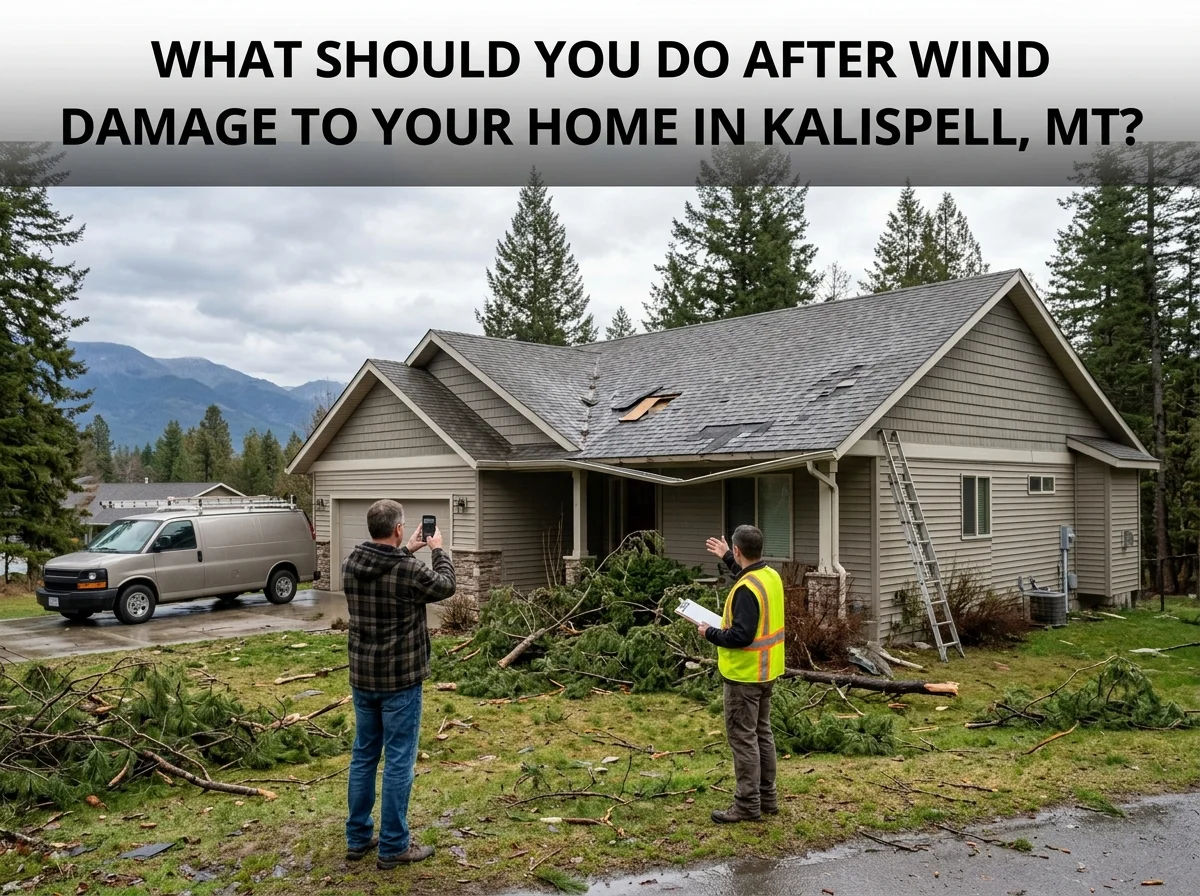

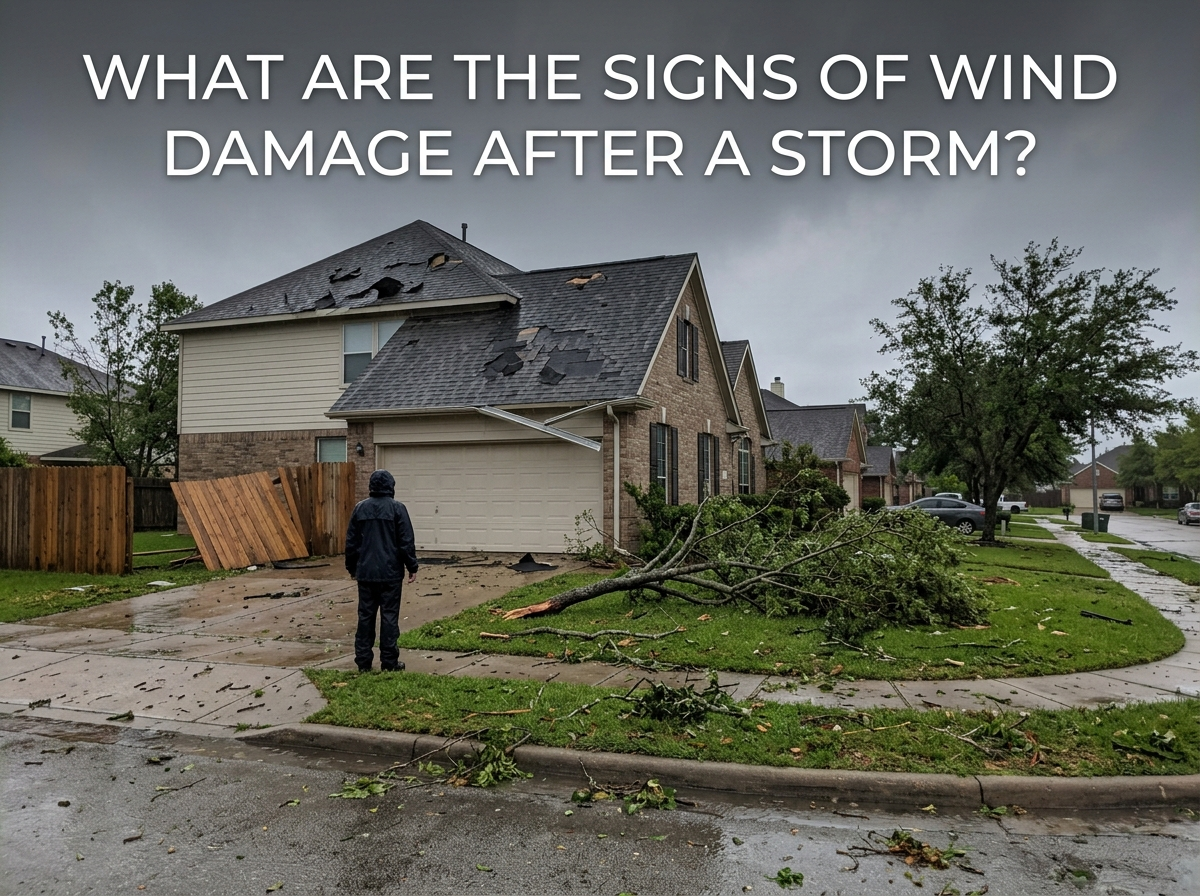
Walk outside and look up. That’s where you start when you’re hunting for signs of wind damage after a storm. Missing shingles are the easy catch. A gutter hanging off the eave comes next. You may also notice broken window glass or siding that has come loose from the wall. Plenty of damage stays hidden, though. You might not notice roof damage while looking from the driveway. This guide helps you check the outside of your home step by step and explains when a quick walk around the yard may not be enough.
Which Roof Changes May Point to Wind Damage?
Look for missing shingles first. You might see a bare patch on the roof. You might find shingle pieces in your grass or the neighbor’s yard.
Picture the roof as layers. Shingles sit on top. Underlayment, a water-resistant sheet, lies beneath them. Wood decking sits under that. When shingles go missing, you may see the underlayment. That tells you the top covering got disturbed in that spot. It doesn’t tell you how deep the damage runs. Bare wood boards are different. Seeing the decking suggests the underlayment is gone there too, so less of the roof’s protection is left.
Don’t stop at the bare spots. Wind damage is not always easy to spot because shingles can stay on the roof after being hit. Look for shingles that sit at an odd angle or appear raised. A clear crease across one may show that a gust bent it backward.. The shingle drops back down and looks normal. That damage isn’t visible from below.
Now check the peak and the metal:
- Ridge caps cover the very top of the roof. Any that look cracked or shifted deserve a note.
- Flashing is the thin metal that seals joints around chimneys and vents. Wind can bend it or pry it loose.
Branches count too. One that lands on the roof can crack or puncture the roofing under it. It may look harmless lying there. Don’t count on that. Here’s the catch. Not every flaw came from the storm. Old roofs curl and wear on their own, and some lose shingles to age. Fresh-looking exposed material is a better clue. So is there new debris nearby, or is damage bunched up in one area? A roofer can sort out the rest.
How Can Siding, Windows, and Gutters Reveal Wind Damage?
Wind hits the walls too. It also throws things at them. Take your time as you check every side of the house for damage.
Exterior siding and trim
Examine each side panel of the siding. Vinyl may crack or split. It may also come out of its locking edge and bow or sag a panel. Wood or fiber-cement boards can crack or move. The edges of windows, doors, and corners are called trim. Where the trim begins to pull away from the wall, there is a gap that can be created. Dents and gouges indicate that there is a possibility that a solid object hit the wall. Spot a panel that is out of line with its neighbors?
Windows, frames, and exterior doors
Start with the glass. Broken panes are easy to spot. Cracks hide better, so look closely. A torn screen or a bent frame can show that something hit the window. A door that won’t latch the way it used to may have shifted. So might a window that suddenly sticks. Don’t jump to conclusions, though. Houses settle, and wood swells when it’s damp. A sticky window proves nothing alone. Near other fresh damage, it matters more.
Gutters, soffits, and fascia
Look up at the roof edge. Gutters attach to the fascia board at the roofline. The soffit is the panel covering the space beneath the overhanging roof. Wind or flying debris can bend a gutter and leave it sagging. It can also pull one loose from the fascia. Soffit panels may hang down or go missing. A damaged gutter is a cue to check the roof edge above it.
What Property Changes May Point to Broader Wind Damage?
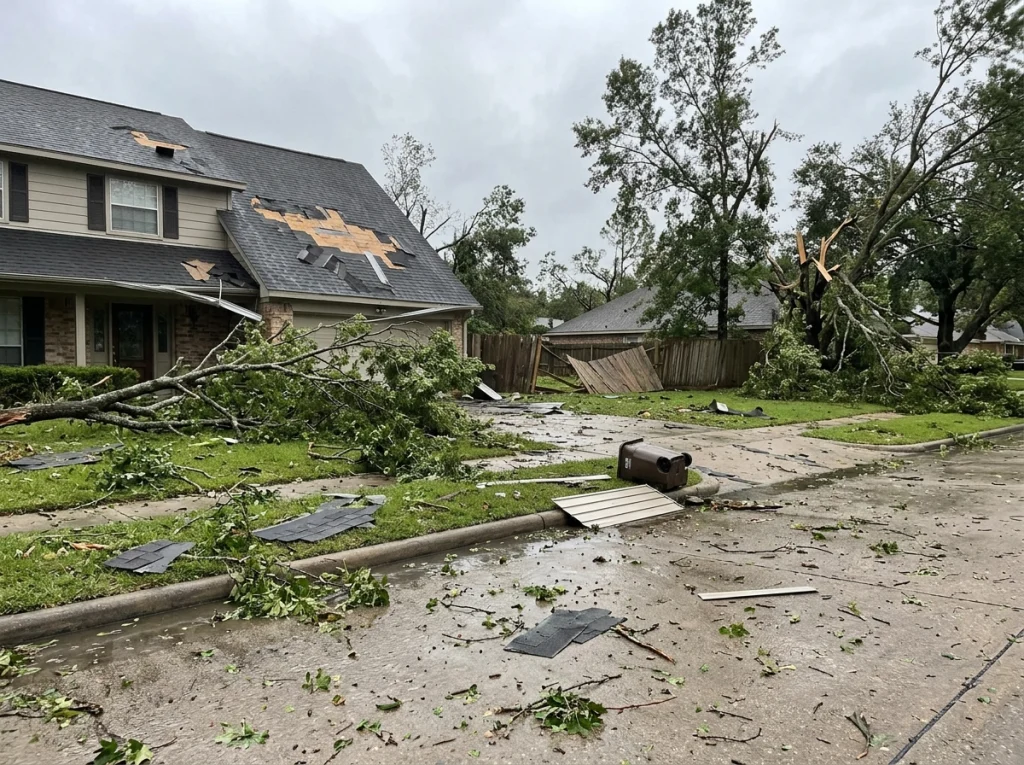
Step away from the house for a minute. Check what a fallen tree or branch landed on. It might be the roof or a fence. Dents and splintered wood show you where it hit.
Don’t ignore the trees still standing. A trunk that leans more than it used to is a red flag. So is soil heaved up at the base. A cracked limb hanging over the house can stay dangerous long after the wind dies down. Keep your distance. Look at fences and outbuildings next. A flat fence panel or a tilted post can reflect strong wind. So can a shed door torn off its hinges.
These are both forms of damage and may be caused by something hitting the property, so there is no reason for it to be apparent just by looking at the damage. Other changes are worth further investigation, such as new cracks in walls, gaps along a porch’s edge, and sloping or irregular walls. Settling can cause the same symptoms, but it may not be possible to determine if there is structural damage from a photograph alone. Get a professional to look at the area to see what is going on.
What Less Obvious Clues Can Suggest Hidden Wind Damage?
Some damage keeps quiet. Exterior materials can look shifted or slightly raised when nothing’s missing. A siding panel might not line up the way it used to. That small change may be your only hint.
Check inside, too. A fresh water stain on a ceiling or wall is a reason to go look at the outside. It isn’t proof of wind damage. Plumbing leaks and condensation can leave the same mark. So can an old roof problem. Damp insulation or a musty smell in the attic works the same way. Treat each one as a nudge to look further. None of them is a verdict.
Some changes you can’t read from the lawn at all. Hairline cracks and loosened sealant hide well. So does damage on a slope facing away from you. You can notice that something looks different. Working out why takes a closer look.
How Can Homeowners Check for Wind Damage Without Taking Risks?
Pick a bright, dry stretch of the day. Walk the property with both feet on the ground. Binoculars or your phone’s zoom let you study the roof from a safe distance. Here’s the short version of a careful check:
- Scan the roofline and chimney from the yard.
- Walk each wall and study the siding and windows.
- Stay off the roof. A damaged one can be slick and weaker than it looks.
- Keep clear of leaning trees and hanging limbs. Stay well away from downed power lines and exposed electrical parts.
- Don’t step into any porch or garage that looks unstable.
A walk-around raises questions. It can’t confirm every shingle or fastener. It won’t show you the far side of the roof. It won’t show what’s behind a wall either.
When Is a Professional Wind Damage Inspection Worthwhile?
Call someone when the damage isn’t limited to one spot. A loose gutter on one side plus a cracked window on another makes a pattern. Loose or shifted roofing or siding is another reason to call. A debris strike counts too, even a small one. Any movement or warping in a wall or roofline needs an expert eye. So does a fresh ceiling stain after a windy night. Can’t tell whether the storm caused something? An inspection can help sort that out.
Here’s what a good inspection does. A qualified professional can assess the visible damage and examine the affected areas within the scope of the inspection. They can also say whether further investigation is needed. No inspection can promise to turn up every hidden problem. Sometimes you get good news.
Local help is close by. Allied 24/7 Restoration covers Kalispell, Whitefish, Columbia Falls, and Bigfork, among other Montana communities. Its wind damage service starts with an inspection that looks for visible and hidden storm damage.
FAQs
Can wind damage occur even if no shingles are missing?
Yes. A shingle can be creased or lifted and still stay on the roof. Flashing can bend or pry up too. Those changes may deserve a closer look. A change alone doesn’t confirm damage, though.
Can you recognize wind damage from the ground?
Partly. Missing shingles and hanging gutters show up from the yard. So do broken windows. A ground-level check can’t show the full condition of a roof or every exterior part. Leave the ladder in the garage. Let a professional take a closer look.
When should a homeowner arrange a professional wind damage inspection?
Call when something looks wrong, and you can’t explain it. Damage in several areas is a good reason. So are loose roofing or siding and debris impacts. A new interior stain counts too. Not sure what you’re looking at? Asking is reasonable.
Recognizing Wind Damage Helps You Protect Your Property
Wind leaves clues all over a property. Some are easy to spot from the yard. Others only show up under a closer look, and many have more than one possible cause. Allied 24/7 Restoration is a Kalispell, MT company that offers wind damage restoration around the clock. If repairs are needed, its wind damage service covers roofing, siding, windows, doors, and structural components. Noticed something odd since the last storm? Call (406) 756-4357 and ask about the free inspection.